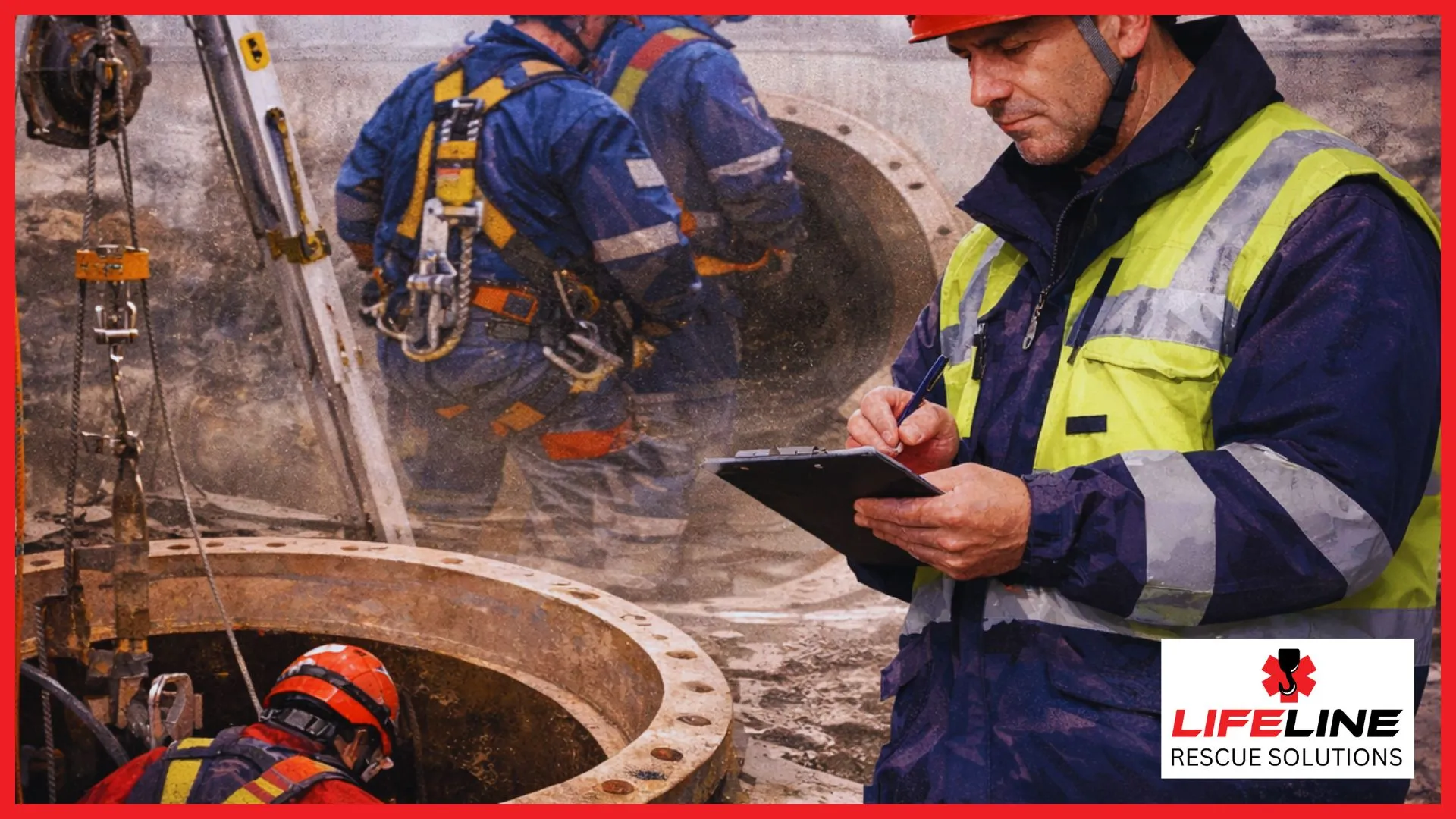
There’s a moment in every confined space audit when the paperwork stops mattering.
Folders are closed. Clipboards come down. And the inspector from the Health and Safety Executive starts asking questions.
That’s where the real audit begins.
Because in confined space work, compliance on paper is only the starting point. What inspectors really assess is whether your safety system works in practice and under pressure, with real people making real decisions.
What Do HSE Inspectors Check in Confined Space Audits?
If you’re preparing for a confined space audit in the UK, inspectors typically assess:
- Worker understanding of risks
- Permit-to-work systems
- Rescue plans and emergency readiness
- Gas monitoring procedures
- Supervision on site
- Equipment condition and correct use
- Worker competence
- Alignment between documentation and real-world conditions
These areas form the foundation of confined space compliance in the UK and reflect how the Health and Safety Executive evaluates safety performance during inspections.
1. People: Do Workers Understand the Risks?
A common misconception is that audits are driven by documentation.
In reality, they are driven by people.
Inspectors often speak directly to workers and ask:
- What are the risks in this space today?
- What would make you stop the job?
- What happens if your gas monitor alarms?
These questions are simple, but the answers reveal everything.
Clear and confident responses show that procedures are understood and embedded. Hesitation or uncertainty suggests that processes exist on paper but are not applied in practice.
This reflects the intent of the Confined Spaces Regulations 1997, where competence and real understanding are central to safe working.
2. Permits: Are They Active Controls or Just Paperwork?
The permit-to-work system for confined spaces is a critical safety control.
However, during an audit, inspectors look beyond its presence and assess how it functions:
- Is it specific to the task?
- Does it reflect current site conditions?
- Has it been properly authorised?
It quickly becomes clear whether the permit is a meaningful control measure or a routine administrative task.
When permits become routine, risk awareness often declines, and that’s a key concern during inspections.
3. Rescue Plans: Would They Actually Work?
Under the Confined Spaces Regulations 1997, a suitable and sufficient rescue plan is a legal requirement.
But in a confined space inspection, having a plan is not enough.
Inspectors will assess:
- How quickly a casualty can be reached and recovered
- Whether rescue equipment is ready for immediate use
- If the team understands their roles without referring to documents
- When the plan was last practised
A rescue plan that has not been tested is, in practice, only an assumption.
Guidance from the Health and Safety Executive makes it clear that relying solely on external emergency services is not considered an adequate arrangement.
For this reason, many organisations work with specialist providers to support confined space rescue planning, helping ensure that response times, resources, and procedures are realistic and effective in real-world conditions.
4. Gas Monitoring: Is It Understood and Used Properly?
Gas monitoring is essential in confined space work, but simply wearing a monitor does not control risk.
Inspectors will check whether workers understand:
- Bump testing procedures
- Alarm set points
- Actions required when alarms activate
The expectation is clear: monitoring must be continuous, understood, and acted upon immediately.
Because conditions in confined spaces can change rapidly, delays in response can have serious consequences.
5. Supervision: Is It Active and Effective?
A named supervisor is not enough.
During an audit, inspectors focus on whether supervision is active and effective:
- Are conditions being continuously monitored?
- Are unsafe behaviours challenged?
- Are decisions made in real time?
Effective supervision is not a role on paper but a visible function on site.
Under the Health and Safety at Work etc. Act 1974, employers must provide appropriate supervision as part of a safe system of work.
6. Equipment: Is It Fit for Purpose and Used Correctly?
Most confined space sites will have the necessary equipment, including:
- Tripods
- Winches
- Harnesses
- Breathing apparatus
Inspectors will check condition, certification, and maintenance records.
But more importantly, they will observe how equipment is used:
- Is the harness fitted correctly?
- Is the retrieval system properly set up?
- Would the equipment function effectively in a rescue?
Having the right equipment is important, but knowing how to use it properly is what really keeps everyone safe.
7. Competence: Can Workers Apply Their Training?
Training records alone do not demonstrate competence.
The Health and Safety Executive defines competence as a combination of training, knowledge, experience, and the ability to apply them effectively.
Inspectors will assess:
- Whether training aligns with job roles
- If refresher training has been carried out
- Whether knowledge can be applied in real situations
A lot of organisations face challenges not because their teams aren’t trained well, but because there’s not enough follow-up support to reinforce what they’ve learned.
Without consistent application, standards can gradually decline.
8. Reality Check: Do Documents Match What Happens On Site?
One of the most effective audit techniques is simple comparison.
Inspectors will review documentation, such as risk assessments, and then observe the work being carried out.
They are looking for alignment:
- Do documented risks reflect actual conditions?
- Are control measures being followed in practice?
If not, it indicates a disconnect between planning and execution.
And that’s something no documentation can conceal.
While documentation is important, inspectors may also question whether the confined space itself has been properly assessed. Ageing structures, signs of deterioration, previous modifications, or evidence of damage may indicate the need for a structural survey before work begins. Understanding when a confined space requires a structural survey can help identify risks that paperwork alone may not reveal.
Conclusion
A confined space audit in the UK ultimately comes down to one question:
If something goes wrong, will this system protect the people inside the space?
Every element, people, permits, supervision, equipment, and rescue, contributes to that outcome.
Experienced inspectors from the Health and Safety Executive can often assess this within minutes of arriving on site, not by reviewing documents, but by observing behaviour.
That’s the reality of confined space safety.
It is built on understanding, discipline, and the ability to act correctly when it matters most.
Need Help Preparing for a Confined Space Audit?
Even well-documented systems can fail under real audit conditions if they are not fully embedded in practice.
If you’re unsure whether your confined space procedures, rescue plans, or permit-to-work systems would stand up to inspection, it’s worth getting an expert review before an auditor does.
Lifeline Rescue Services provides specialist confined-space consulting to help you identify gaps, strengthen compliance, and ensure your systems work in real-world conditions, not just on paper.
From reviewing rescue plans to assessing on-site practices, our team can help you prepare with confidence.
Frequently Asked Questions
What happens during an HSE confined space inspection?
Inspectors assess how safety systems work in practice, including worker knowledge, permits, rescue plans, gas monitoring, supervision, and equipment use.
Can you fail a confined space audit in the UK?
Yes. If inspectors identify serious risks, poor understanding, or ineffective controls, enforcement action may be taken, including improvement or prohibition notices.
How often should confined space rescue plans be tested?
Rescue plans should be practised regularly and whenever conditions, equipment, or personnel change.
Is a permit-to-work required for confined spaces in the UK?
While not always explicitly mandated, a permit-to-work system is widely recognised as essential for managing confined space risks and demonstrating compliance with UK regulations.